
Edgefield Scheduled and Actual Release
A scheduled or projected date is an administrative estimate based on the sentence information and credit assumptions available at the time. An actual release date records the event after the person leaves that custodian. Those dates can match, but they do not have to. SCDC recalculates state sentences under South Carolina law, while Edgefield County jail timing depends on the court order, bond, local sentence, and any other authority with a hold.
Pretrial detention adds a key limit. A person held while a case is pending does not have a sentence-based release date. Bond may be posted, a court may change conditions, the case may end, or another authority may take custody. Court dockets can show the legal event, but the detention center confirms whether and when the person physically left.
- Projected date
- A calculated future date subject to change.
- Max-out date
- The end point produced by the sentence calculation before applicable changes.
- Detainer
- A request or hold from another authority that may affect where the person goes.
- Discharge
- An end of custody or supervision as defined by the issuing agency.
Find Edgefield Projected Release Dates
Begin with the system that currently holds the person. Edgefield County includes the county detention center, SCDC's Trenton Correctional Institution, and federal FCI Edgefield. Each produces a different record. The ordinary SCDC current-inmate search applies only to people presently sentenced to and incarcerated in SCDC. Its disclaimer says the data are current as of midnight the prior day and exclude released people, county-sentenced detainees, and people on community supervision.
- Identify whether the person is in county, state, or federal custody.
- For current SCDC custody, search by name or SCDC ID and open the detail report.
- For an Edgefield County detainee, call the detention center and review the court case.
- For a federal sentence, use the BOP locator rather than an SCDC tool.
- Record the displayed label and date without renaming it as a guaranteed release.
- Recheck the custodian close to the date and confirm the actual departure afterward.
The SCDC search disclaimer explains coverage and timing. If a current SCDC record appears wrong, the agency provides its inmate information line at 1-866-727-2846 and Ombudsman@doc.sc.gov for apparent data errors. The search result should be tied to the correct person through neutral identifiers.
After release from SCDC, switch to the separate Released Inmate List. The current search intentionally omits released people, so disappearance alone proves nothing. The full Edgefield County released inmate search path explains how to reconcile the state list, county record, and court docket.
Edgefield SCDC Date Calculator
SCDC publishes a release-date calculator, but it is not an official individual record. The calculator describes its output as an earliest possible case scenario. It assumes all possible credits and asks about factors such as prior or subsequent convictions and Youthful Offender Act status. Those inputs show why a general estimate cannot replace the agency's calculation for a named prisoner.
The calculator can help a reader understand how sentence length and statutory credits interact. It should not be used to announce a person's release day. Actual credits may differ, disciplinary loss can change the result, and the agency may have sentence or conviction details not known to the user. SCDC's own record and Inmate Records channel remain the sources for the agency's current calculation.
The official calculator screen illustrates the distinction. View the SCDC calculation fields before reading the captured reference image.
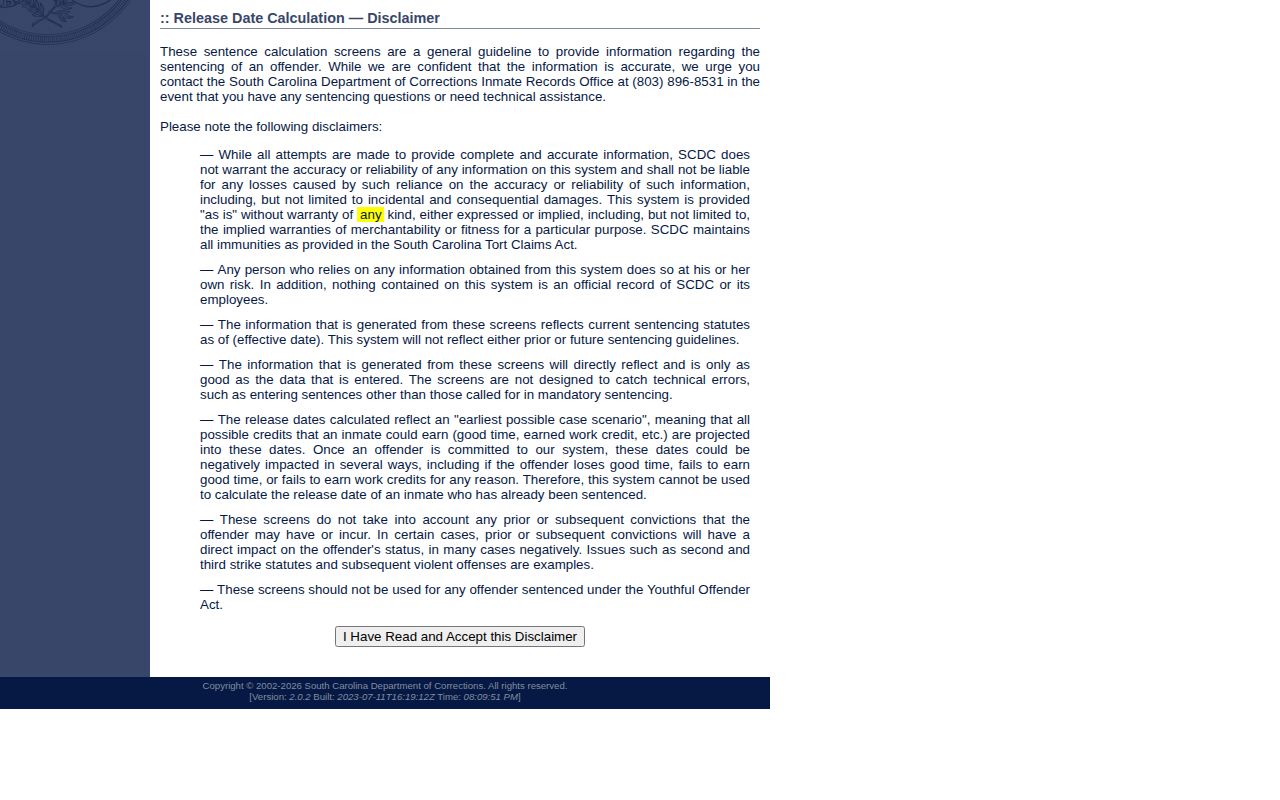
The form's earliest-case warning and credit questions make clear that its result is conditional, not a certified release record.
Edgefield Release Credit Rules
South Carolina's sentence-credit rules appear in Title 24, Chapter 13. Section 24-13-210 addresses good-behavior credit for eligible prisoners. The research identifies a general rate of twenty days for each month served for prisoners convicted on or after June 21, 1996, subject to statutory eligibility and loss rules. A person sentenced before that date may fall under a different rate. The statute, not a broad summary, controls.
Section 24-13-230 covers earned work and education credits. Eligible participation can produce additional credit, but statutory caps and exclusions apply. These are not automatic promises. SCDC must apply the correct version of the law to the person's offense, sentence, conduct, and program record.
| Factor | Effect on the estimate |
|---|---|
| Good-behavior credit | May reduce time for an eligible sentence; credit can be lost |
| Work or education credit | May add earned credit within statutory limits |
| Sentence type and offense date | Determine which rules and exclusions apply |
| Disciplinary action | Can reduce or remove credit |
| Sentence correction or court order | Can change the base calculation |
| Detainer or transfer | May change destination without changing the fact of exit from SCDC |
Note: Credits alter eligible sentence calculations; they do not guarantee community release on the first date an informal calculator produces.
Edgefield Release Percent Rules
Two South Carolina percentage rules must not be merged. Section 24-13-125 uses an 80-percent threshold for work-release eligibility in the circumstances it covers. Section 24-13-150 establishes an 85-percent early-release and discharge floor for defined no-parole offenses. The first concerns eligibility for a program. The second limits release and discharge for a statutory class of offenses.
It is inaccurate to say that every South Carolina prisoner serves 85 percent. A correct calculation requires the conviction, offense classification, offense date, sentence, and applicable credit provisions. Even when the 85-percent floor applies, the official SCDC calculation remains the relevant person-specific source. Parole eligibility rules also should not be recast as a release date.
The official Chapter 13 text should be read with the SCDC record. General descriptions can explain the framework, but they cannot decide an individual sentence.
Why Edgefield Release Dates Change
A future date can move when new information reaches the custodian. SCDC may apply earned credit, remove credit after a disciplinary finding, correct sentence data, or account for another conviction. A court order may amend a sentence. Parole action can affect the path out of custody without making a hearing date an actual exit date.
Another agency's hold affects interpretation. A positive detainer can mean the person leaves one prison and enters another authority's custody. That is a release from the first custodian, but not necessarily a return to the community. The SCDC Released Inmate List includes a detainer indicator in its export fields, which should be preserved when destination matters.
| Change | What to verify |
|---|---|
| Credit earned or lost | Current SCDC calculation |
| New or corrected sentence | Court order and SCDC record |
| Parole decision | Person-specific board result and custody record |
| Detainer | Receiving authority and release type |
| Transfer | Whether custody continued elsewhere |
| Administrative lag | Timestamp and direct agency confirmation |
Edgefield County Jail Release Dates
The Edgefield County Sheriff's Office states that there is no online inmate lookup. For a person at the Edgefield County Detention Center, call 803-637-4124 and ask whether the person remains physically confined. If not, ask for the departure date, release or transfer classification, and receiving agency. A pretrial detainee may have no projected date to report.
Check the Edgefield Public Index for bond, disposition, sentence, and filed orders. The docket can show the legal authority for a release, yet it may not capture the exact physical exit time or another jurisdiction's hold. Request the booking and release record from Sheriff's Office Records when documentary proof is needed.
A county sentence must not be searched as though it were an SCDC sentence. Conversely, transfer from the county jail into SCDC is not community release. Identify the receiving system and continue there.
Edgefield State Release Date Evidence
A projected SCDC date and a Released Inmate List entry answer different questions. The projected date concerns a person who remains in state custody and reflects the agency calculation available at that point. The released list documents a completed departure from SCDC custody. When timing is uncertain, retain both records with the date each was checked rather than replacing the earlier estimate with an undocumented assumption.
The released-list form requires a beginning date, ending date, and county selection. It does not offer a name field. Search a defensible interval, review all result pages, and use the SCDC ID to distinguish similar names. The ordinary table can display SCDC ID, name, sex, race, age, sex-offender indicator, release date, release type, and county. Export adds SID, Victim, Detainer, and MSO. Keep MSO as the agency label because the research found no official expansion for it.
Release type changes the interpretation. Values documented in Edgefield-filtered results include RELEASE, PROBATION, and INTENSIVE SUPV. Probation or intensive supervision indicates that physical SCDC confinement ended on the listed date while legal control may continue in the community. A positive detainer can point to another government custodian. The narrow statement is that SCDC recorded release on the shown date and type, not that the person was free from every hold or supervision term.
The list does not define its County field as the institution where release occurred. An Edgefield-filtered row is therefore not proof of departure from Trenton Correctional Institution. It also cannot document an Edgefield County Detention Center release because county detention is outside SCDC. Confirm the institution or destination through SCDC Inmate Records when that distinction matters.
Edgefield Parole Dates Are Conditional
A parole hearing date is not a projected release date. South Carolina Board of Paroles and Pardons scheduling shows when a decision process may occur, while the person-specific result shows the outcome. SCDPPPS says individual hearing dates generally become available about thirty days before the hearing. An annual calendar alone cannot establish that a named prisoner will be heard or released.
Eligibility also differs from a granted decision. Title 24, Chapter 21 supplies the parole framework, but a person may be eligible for consideration without receiving parole. Even a favorable result should be checked against the SCDC custody record before an actual release is reported. If release leads to parole supervision, the SCDPPPS search and county office address the next legal stage, not the earlier prison calculation.
Keep the sequence clear: sentence calculation, eligibility, scheduled hearing, decision, custody departure, and supervision are distinct events. Their dates may come from different agencies and update on different cycles. A reliable Edgefield County release-date account labels each event by its source instead of collapsing them into one promised day.
Confirm Edgefield Actual Release
After the projected day passes, verify the event with the custodian. For SCDC, search the separate Released Inmate List by date range and county, then preserve the SCDC ID, release date, release type, and detainer indicator. The list's Edgefield county filter is not defined as a facility filter, so a result cannot automatically be called a departure from Trenton Correctional Institution.
For the county jail, pair the release record with the court docket. For federal custody, use BOP. If a custody-change alert is helpful near the expected date, the VINELink Release Check explains registration and coverage limits. A VINE alert remains a signal from the reporting agency, not an independent sentence calculation.
Use the narrowest accurate statement: projected by SCDC, released from SCDC on the listed date, transferred to another authority, or confirmed out of the county detention center. This wording keeps estimates, custody changes, and community return from being confused.
Public Record Search
Sponsored Results